guide
A Home That Remembers for You
· KoniYou're already at the tram stop when the thought arrives: did I switch off the stove? You go back. It was off. Tomorrow it'll be the keys, the day after the appointment you were sure you'd remember.
For many adults with ADHD, this isn't occasional. It's daily life. And it has very little to do with not trying hard enough.

A note first: I'm not a doctor, and this post is not medical advice. If you think ADHD might affect you, a qualified clinician is the right first step.
Forgetting is part of the picture
The official diagnostic criteria for ADHD literally include "often loses things", with keys, wallets and mobile phones as examples, and "is often forgetful in daily activities", like chores, errands, paying bills and keeping appointments. Depending on the definition, studies estimate that between about 1 in 40 and 1 in 15 adults worldwide are affected.
In adults, the visible restlessness of childhood often turns inward. What stays is the difficulty of remembering to do something at the right moment, judging time and starting tasks.
What helps, according to research
The best-supported approach is not "trying harder" and not brain-training apps. Training apps improve scores in the app, but studies show the effect doesn't carry over into daily life.
What does help is structure outside your head: calendars, task lists, breaking big jobs into small steps, and reminders placed exactly where and when the action happens. Psychologists call this the "point of performance". The reminder to take the keys belongs at the door, not in a notebook.
That's where a home can help. I want to be honest, though: there are no studies yet on smart homes for ADHD. What follows is applying a well-supported principle, cues in the right place, with today's technology. It's not a proven treatment.
Reminders where you need them
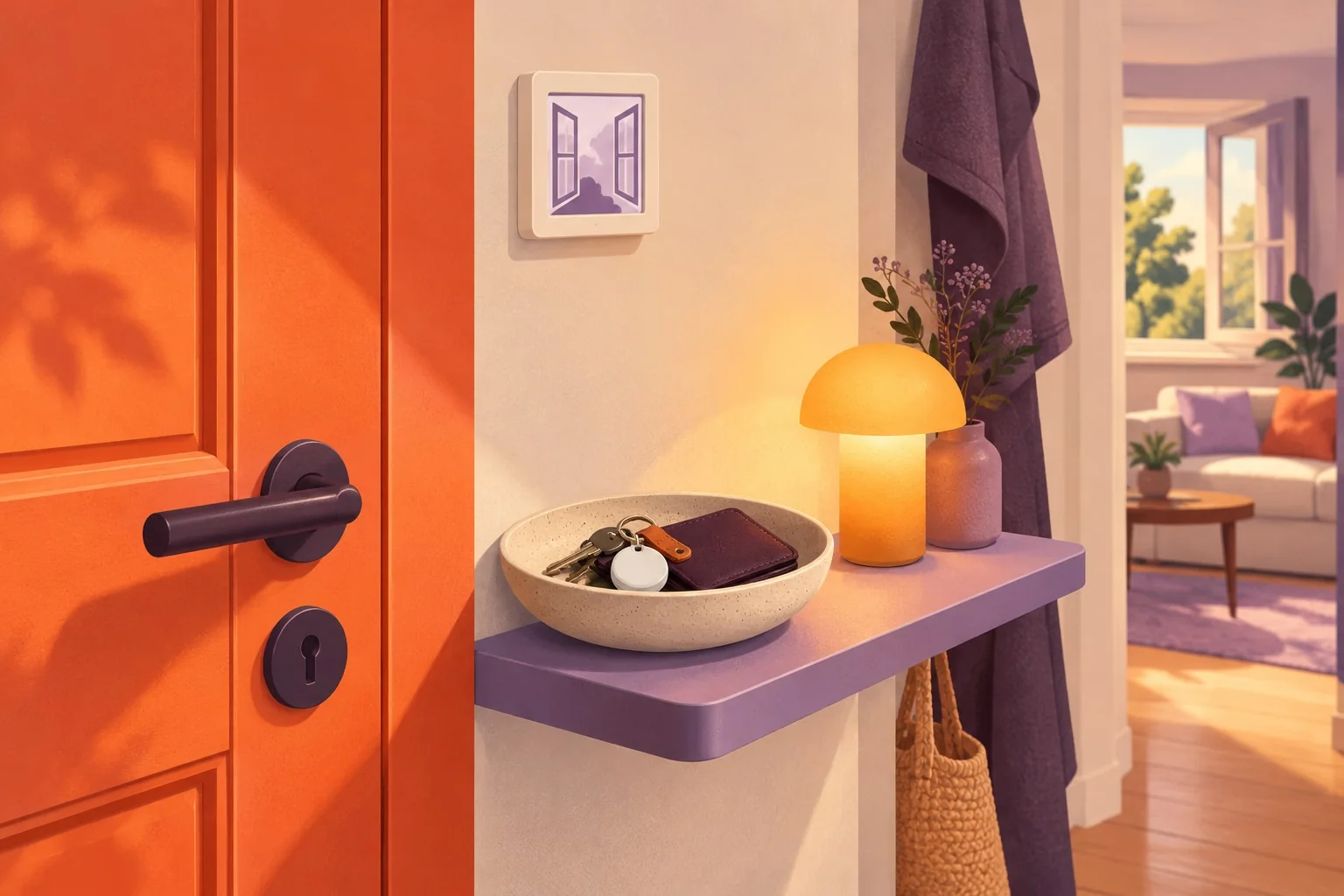
- At the front door. When you leave, a small light by the door turns amber if a window is still open or the iron is still on. One glance, before the door closes.
- The stove question. An iron or a kettle on a smart plug can be checked from your phone, or switched off automatically after a while. For the stove itself, an electrician can fit a stove guard that switches it off if it's left on.
- Time you can see. Ten minutes before you need to leave for an appointment, the hallway light changes colour. Time becomes visible instead of something you have to keep track of in your head.
- Things that are done. The washing machine sends a message when it's finished, so the laundry doesn't sit wet in the drum for a day.
- Keys and wallet. A fixed place by the door, plus a small tracker on the key ring that shows where they are.
- Winding down. In the evening, the lights dim at the same time every day, a gentle signal that the day is ending.
A reminder is help, not control
Two things are important to me here. First: you decide what the home reminds you of, and how. Some people want a light, others a message on their watch, and some want nothing at all for certain things. Second: a reminder only helps if it isn't annoying. Too many signals turn into noise, and noise gets ignored. So we start small, with the one or two things that bother you most, and add more only if it helps.
This also applies to the people you live with. A reminder in the hallway is visible to everyone. It should support, not expose.

Where to start
In my post on the pain points we stopped noticing, I describe how I approach every home: not with a shopping list, but with the question of what you do every day without noticing it anymore. With ADHD, that list is often longer, and the gain from each small fix is bigger. And everything can be seen at a glance in the Konihaus™ app, from wherever you are.
Curious which reminder would help you most? Talk to Koni. The first conversation is free, with no obligation.